
WVC 테솔 - 공부기록 (Unit 5~8) |
EUIJIN 2025-05-26 조회수 : 2,782 |
|
두 번째로 올리는 WVC 테솔 공부기록! 점점 내용이 깊어질수록 더 재밌고 또 도움이 되는 테솔 공부, 스타트⭐️ 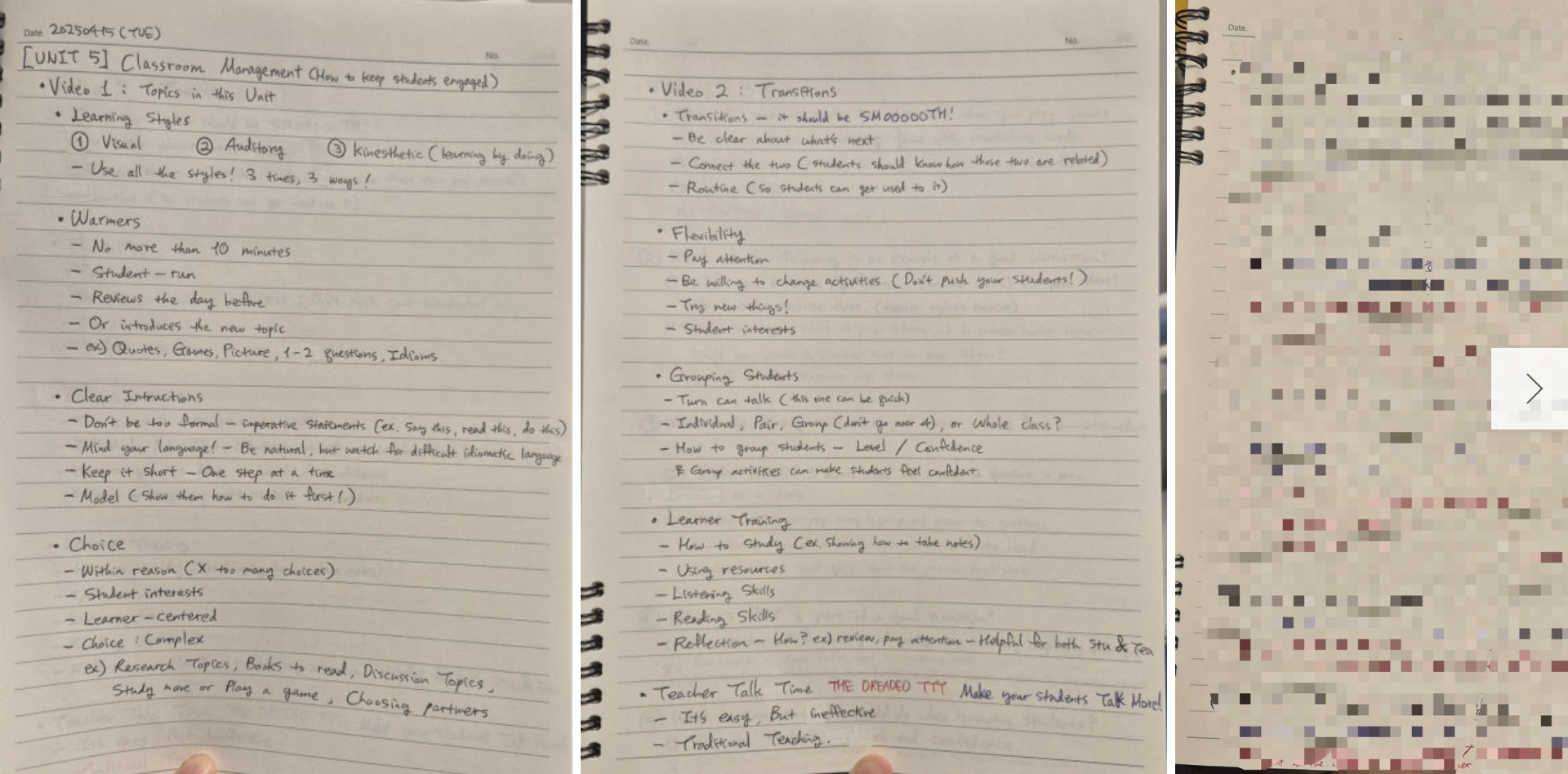 [UNIT 5] Classroom Management (How to keep students engaged) Previous imageNext image WVC 테솔 Unit 5에서는 효과적으로 교실 환경을 조성하는 방법과 학생들의 적극적인 참여를 어떻게 유도할 수 있는지를 배운다. 선생님보다 학생들이 더 말을 많이 하는 환경이 좋고, 몸의 감각들을 최대한으로 활용하며 공부하는 것이 좋다. 너무 길게 하기보다는 짧고 재밌게, 학생마다 다 좋아하는 것과 공부 방법이 다르니 그에 맞춰 유연하게 대응하는 능력도 필요하다고 한다. Video 1 : Topics in this Unit - Learning styles 1. Visual / 2. Auditory / 3. Kinesthetic(learning by doing) Use all these styles! 3 times, 3 ways! - Warmers - No more than 10 minutes - Student-run - Reviews the day before - Or Introduces the new topic - ex) Quotes, Games, Picture, One-two questions (ISLcollective-videos), Idioms - Clear Instructions - Don’t be too formal - imperative statements(ex. say this. do this. read this.) - Mind your language! - Be natural, but watch for difficult idiomatic language - Keep it short - One step at a time - Model (show them how to do it first!) - Choice - Within reason(X too many choices) - Student interests - Learner-centered - Choice: Complex (Research Topics / Books to read / Discussion Topics / Study more, Play a Game / Choosing partners) Video 2 : Transitions - Transitions - SMOOOOOOOOTH - Be clear about what’s next - Connect the two (students should know how those two are related) - Routine (so students can get used to it) - Flexibility - Pay attention - Be willing to change activities (Don’t push your students!) - Try new things! - Student interests - Grouping Students - Turn and talk (This can be quick) - Individual, Pair, Group(don’t go over 4), or Whole Classs? - How to group students - Level, Confidence - Learner Training - How to study (ex. Showing how to take notes) - Using resources - Listening Skills - Reading Skills - Reflection - How? ex. review, pay attention - Helpful for both Student & Teacher - Teacher talk time THE DREADED TTT - It’s easy - But ineffective - Traditional Teaching - Make your students talk more! Video 3 : Q&A  [UNIT 6] Assessment Previous imageNext image WVC 테솔 Unit 6에서는 학생들의 능력을 평가하는 방법들에 대해서 배운다. 시험도 그 개념에 포함되긴 하지만 assessment는 그거보다는 더 큰 개념이다. 시험말고 놀이나 게임으로도 할 수 있으며, 어떤 능력을 알아보고 싶은지에 따라 여러 방법을 사용할 수 있다. 학생이 최대한 부담을 느끼지 않도록 하는게 좋다. Video 1 : Types of Assessment What is assessment Why “Assessment”? - Because the word ‘TEST’ is too stressful. And assessment is a bigger concept than that. Assessment = gathering information - Skills gained - Skills that need improvement - Teaching practices - Student study habits - Review Types of assessment Summative - Tests & Quizzes - Presentations - Papers - Final products - State/National Exams - Portfolios Formative - Practice - Student involvement - Descriptive feedback - Games - Exit Slips - Q & A - Peer review - Goal Setting - Tips 1. Be concious 2. Plan ahead 3. Don’t tell the students what you’re doing! 4. Reflect Testing Reasons 1. Placement - What level are they in right now? Pleacement tests - Usually the institution (school, company, university) - Be aware(Does it have all parts? Is it effective?) - Make suggestions - Help with testing - All four skills! - But integrated - Strenghts & Weaknessess - Affects level placement Diagnostic Tests(Problems) - ‘Needs Assessments’ - Beginning - Adult learners - Ungraded - Info about students: hobbies, interests, family, technology, etc. Achievement Tests (Progress) - Progress Quiezzes Mid-terms Games Few and specific objectives Flexible scoring — Final Achievement Summative Based on course objectives Watch progress tests! Study guides, etc. Variety 2. Problems - What problems do they have? 3. Progress - How much have they learned? 4. Proficiency Video 2 : Error Correction Proficiency Tests - TOEFL (Test of English as a Foreign Language) - United States - IELTS (International English Language Testing System) - Britain and Australia - CEFR (Common European Framework of Reference for Languages) - A1-C2 - College Entrance Exams (CSAT, etc.) Be aware of your students’ plans - Help them if you can! - Preparing Students for Standardized Tests Study skills (memorizing vocabs, analyzing reading Health (Physical & Mental) Practice tests vs. Practice Plan & Set Goals (students - relaxed, ready) Managing Test Anxiety (Prepare well, Breath deeply, Relax, Engage in positive self-talk, Remain calm)(ex. 50 Ways to Take a Break) Designing a Test - VERY clear instructions - Space! - Relevant images - Variety of question types - Clearly section - Point values Types - Fill in the blank (it’s good for vocab) - Multiple choice - Cloze - Statement and response - Reading & response - Image & response - True/False - Matching - Scrambled sentences - Dictation Correcting Errors (AKA : How to encourage your students) - Sources of Errors - Mistake vs. Error - Predict & Prepare - Cognates (다른 언어의 단어와 소리가 똑같은데 영어로는 아예 다른 뜻인 경우 헷갈림) - Over - generalization - Other learners - Backsliding - How to make those corrections - Think how YOU want to be corrected - Pay close attention - Plan ahead - Focus on language function - Recasting & Echoing - Whole - group - Don’t interrupt - Interrupt - Don’t Frown, Smile. Mistakes are awesome! Video 3 : Q&A  [UNIT 7 : Course Design and Lesson Planning] Previous imageNext image WVC 테솔 Unit 7에서는 수업을 어떻게 계획하는지에 대한 내용이다. 어떤 교과서를 고르고, 그 교과서를 어떻게 하면 효과적으로 이용할 수 있는지, 교과서 이외의 자료들은 어디서 찾으면 좋은지에 대해 배운다. 수업 자료는 최대한 다양하게 해야 학생들의 흥미도 유도하고, 더 재밌게 공부를 할 수 있게 된다고 한다. Video 1 : Designing your Course Context in Course Design - Students - Resources - Admin - Standards - Physical Setting - Time Designing your course - Backward Design - Identify desired results - Determine acceptable evidence - Plan learning experiences and instruction - Assessments - SLA Establishing Curricular Priorities 1. Enduring Understanding - most important 2. Important to know and do 3. Worth being familiar with - least important Project - Based Learning - Starts at Course Design - Creative - Choice - All 4 language functions - Motivated & Involved - Authentic - HOWEVER - takes time. - The 7 - Phase Model 1. Introduction of Driving Question 2. Intro of Culminating Challenge 3. Develop Subject Matter Expertises 4. Doing the Culminating Challenge 5. Debriefing CC ( Subject Expert) 6. Responding to Driving Question 7. Summative Assessment Choosing a RIGHT Textbook - Talk to people! - Look online - Variety - Cultural components - Presentation - Practice Using a Textbook - Presentation : add to / explain in more detail - Skip & adapt - Supplement - videos, images, games, worksheets, etc. - Teacher’s guide - ideas for presentation, etc. - Charts, appendices, etc. - DVDs, CDs, etc. No textbook? That’s ok! - Allthingsgrammar.com - Allthingstopics.com - Islcollective.com - Dave’s ESL cafe - http://www.eslcafe.com/ Home Page - ESL MA TESOL & POST-BAC CERTIFICATE Advertise with ESL Cafe Now! Looking for a way to promote your products and services on the #1 ESL Website on the Net? Email Dave to get started now! Advertise with ESL Cafe Now! Looking for a way to promote your products and services on the #1 ESL Website on the Net?... www.eslcafe.com - BBC - http://www.bbc.co.uk/learningenglish/ BBC Learning English - Learn English with BBC Learning English - Homepage www.bbc.co.uk - BNE - https://breakingnewsenglish.com Breaking News English - Easier News Lessons English News Lessons in 7 levels with graded multi-level listening and variable scrolled-reading, and all-skills activities. breakingnewsenglish.com Video 2 : Choosing a Textbook - All four modalities - All learing styles - VARIETY!!! Make sure… - Specific - but not too specific - Anticipate problems (what willl you need to go over?) - Timing! - Materials! - set up early! - Keep the plans & write notes Lesson Plan Formats - Practical - Useful - to - whom? - Clear - Detailed Teaching Strategies PPP - Present - involve students! - Practice - detailed - Produce - larger scale ARC - Authentic - Practice - Fix issues / Answer Questions TTT - Test - but not really? - Teach - involve students! - Test - but not really! Video 3 : Q & A  [UNIT 8 : Teaching Reading] Previous imageNext image WVC 테솔 Unit 8 에서는 영어로 읽기를 어떻게 하면 효과적인지에 대해 배운다. 소리내어 읽는거는 읽으면서 내용을 습득하기 보다는 단어들을 발음하는 데에 더 신경을 많이 쓰게 되기 때문에 생각보다 읽기에 도움이 안된다고 한다. 목적에 따라 글을 읽는 방법이 달라져서(예: 특정 정보를 찾기 위한 읽기, 주제를 찾기 위한 읽기, 재미를 위한 읽기 등) 그 목적에 따라 읽는 방법들을 익혀야 한다. 글을 읽다보면 다양한 단어들을 접하게 되는데, 7~14개를 넘어가면 기억에 남지 않으니 주의! Video 1 : Notes about reading in English Notes about reading in English - First : translating - Goal : without translating - Takes years - VERY careful planning - Reading is NOT pronunciation Reading Strategies - WHY are students reading? - Reading for detail ex) Deciding what to eat from a menu - Scanning ex) Trying to find a phone number in a directory - Skimming ex) Reading 50 pages of a text in an hour Intensive Reading - Detail - Meaning - Feelings Why? - Grammatical features - Vocabulary in context - Discourse markers 4 steps 1. Create interest 2. Pre-teach vocabulary 3. Give a reading task 4. Follow up activities Extensive Reading - Reading is FUN! - Exposure : fluency and acquisition - Level - appropriate Video 2 : Extensive Reading Authentic Readings - Real - world language - Authentic content - Longer - Idioms ex) Newspapers, magazines, Kid’s Books Created Readings - Level - appropriate - Control over content - Shorter - Limited idioms ex) Teacher-created, Company-created Which one should we use? BOTH! Ex) Graded Readers - Level - appropriate - Control over content - Shorter - Limited idioms - Engaging without being overwhelming ex) Breaking News English http://breakingnewsenglish.com/ Breaking News English - Easier News Lessons English News Lessons in 7 levels with graded multi-level listening and variable scrolled-reading, and all-skills activities. breakingnewsenglish.com , Longman Classics, Penguin Readers Basic Reading Problems - Literacy - Different alphabets - Student levels Reading & Speaking - Remember : Reading is NOT pronunciation! - Read, understand, discuss - Follow-up activities Reading & Writing - Not always Read & Respond - Fill - in - the - blank - Mad Libs - Follow with an extended writing activity - VERY carefully outlined - Scaffold (build up to) Vocabulary in Context - Recognition - Denotation - Connotation - Collocation - Grammar - Sound / Pronunciation - Register Things to remember : - 7 -14 - Relevant - Practice - Active vs. Passive - Lexical sets : differentiate - Synonyms : higher levels - Guessing - Word formation - Help students remember Use Dictionary! Video 3 : Q & A WVC 테솔 Unit 5~8까지 공부하며 느낀 점 : 되게 당연한거 아니야? 라고 생각했던 개념들을 다시 한번 확실하게 복습하는게 생각보다 큰 도움과 공부가 되는 것 같다. 점점 가면 갈수록 수업 영상이 길어지는 느낌이다. 처음엔 음 이정도면 들을만 하군! 하고 방심했다가 어? 할 때가 가끔 있음.. 가끔 수업 중 수업 모델을 제시해주면서 한번 해보면 좋을 듯한 활동들을 추천해주는데 꼭 과제처럼 제대로 만들어보진 않더라도 그 주제에 대해서 더 깊게 생각해볼만한 계기를 주는 것 같아 좋은 것 같다. 선생님이 참 또박또박 잘 알아듣게 설명해주신다. 영어 실력이 유창한 사람들은 2배속으로 들어도 될 듯! 수업 자료를 어디서 구하는게 좋을지가 고민중 하나였는데 여러 사이트를 알려줘서 도움이 많이 될 것 같다. |
|

오늘 하루동안 보지 않기 닫기